
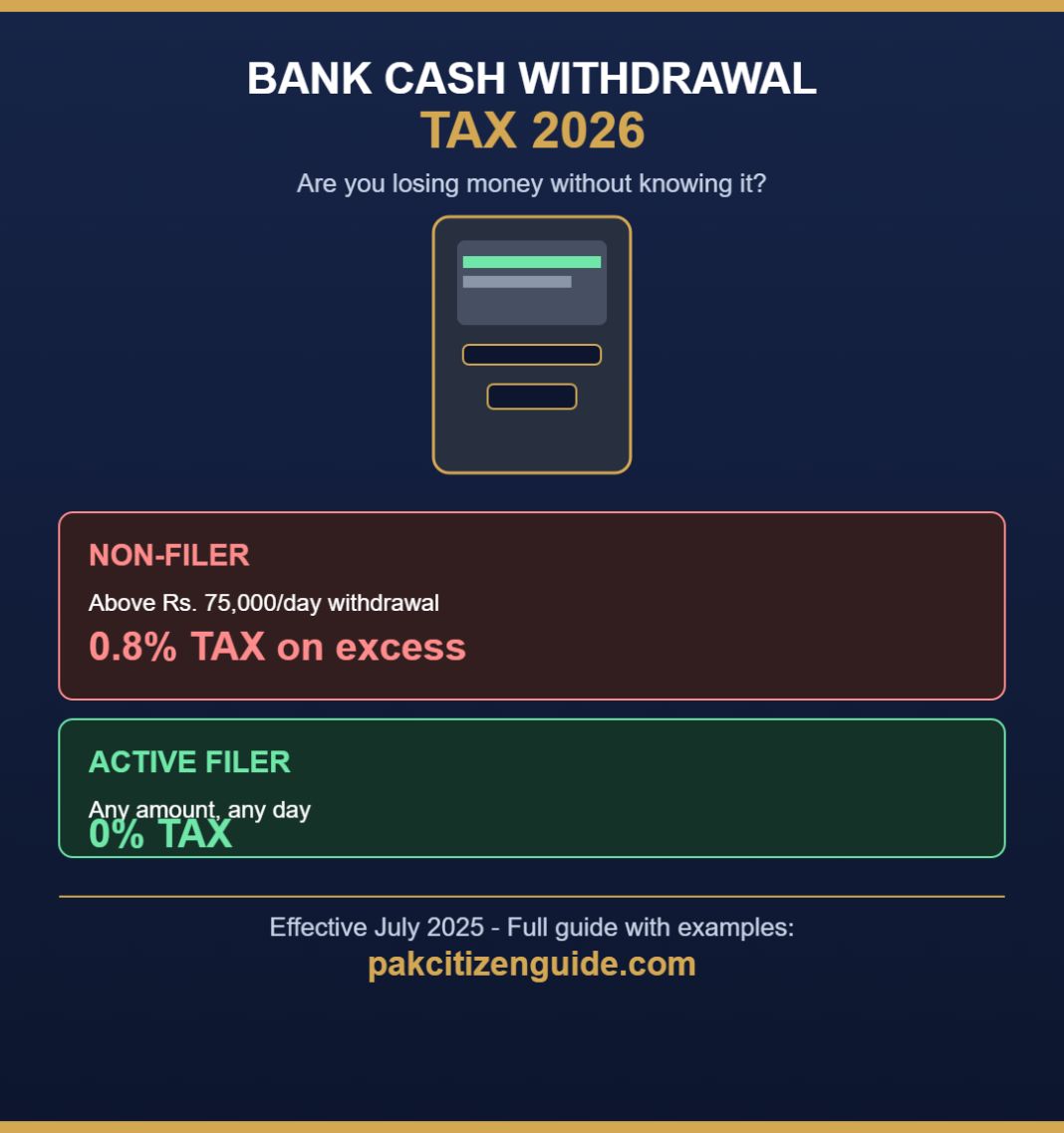

If you’ve ever withdrawn cash from your bank and noticed a small deduction you didn’t expect, that’s Pakistan’s withholding tax on cash withdrawals — and in 2025-26, both the rate and the tax-free threshold changed. Here’s exactly how it works in 2026, whether you’re a filer or not.
What Is the Cash Withdrawal Withholding Tax?
Under Section 231AB of the Income Tax Ordinance 2001, banks are required to deduct withholding tax at source when a non-filer withdraws cash above a daily threshold. This tax exists to encourage documentation of the economy and push more people to register as active taxpayers. It applies per person, per day, across cash withdrawals — not per transaction.
Current Rate and Threshold (2026)
| Filer Status | Daily Tax-Free Limit | Tax Rate on Excess |
|---|---|---|
| Active Filer (on FBR’s ATL) | No limit — fully exempt | 0% |
| Non-Filer | Rs. 75,000 per day | 0.8% on the amount above Rs. 75,000 |
This threshold and rate took effect July 1, 2025, as part of the 2025-26 Finance Act. It replaced the previous rule, which set the threshold at Rs. 50,000 with a lower 0.6% rate.
How the Tax Is Calculated
The tax applies only to the amount that exceeds the daily threshold — not the entire withdrawal.
| Scenario | Calculation | Tax Deducted |
|---|---|---|
| Non-filer withdraws Rs. 100,000 in one day | (100,000 − 75,000) × 0.8% | Rs. 200 |
| Non-filer withdraws Rs. 50,000 in one day | Below threshold | Rs. 0 |
| Filer withdraws Rs. 200,000 in one day | Fully exempt | Rs. 0 |
Who Is Exempt?
- Active tax filers — anyone listed on FBR’s Active Taxpayer List (ATL) is completely exempt from this withholding tax, regardless of withdrawal amount.
- Certain Asaan Accounts and branchless banking accounts may qualify for special relief depending on eligibility.
- Withdrawals traceable to properly documented foreign remittances may be exempt under specific conditions.
Tax vs. Bank Charges — Don’t Confuse the Two
The withholding tax is separate from ordinary bank service charges like ATM fees, SMS alerts, or card maintenance fees. Those are charged by your bank regardless of filer status; the withholding tax is a government tax collected on FBR’s behalf and only applies to non-filers above the threshold.
Why This Matters: Becoming a Filer Pays Off Immediately
Unlike some tax benefits that take a year to materialize, the filer exemption on cash withdrawals applies the moment your name appears on the ATL — often within days of registering. For anyone who withdraws cash regularly, this alone can offset much of the effort of becoming a filer, on top of the other benefits filers get on property transactions, vehicle registration, and prize bond winnings.
Frequently Asked Questions
What is the current cash withdrawal tax rate for non-filers in 2026?
0.8% on the amount withdrawn above Rs. 75,000 in a single day, effective since July 1, 2025.
Do filers pay any tax on cash withdrawals?
No. Active filers on the FBR’s Active Taxpayer List are fully exempt, regardless of how much they withdraw.
Is this tax charged per transaction or per day?
Per day. Banks track your total cash withdrawals across the day and apply the tax to the cumulative amount above the threshold, not to each individual withdrawal.
Can I get this tax refunded?
If you’re a filer who was mistakenly charged, or if the withholding exceeds your actual tax liability, you can claim an adjustment when filing your annual income tax return through FBR’s IRIS portal.
What was the rate before this change?
Previously, the threshold was Rs. 50,000 per day with a 0.6% rate on non-filers. Both the threshold and rate increased in the 2025-26 Finance Act.
Final Thoughts
The math is simple once you know the two numbers that matter: Rs. 75,000 daily threshold, 0.8% on the excess for non-filers, zero for active filers. If you withdraw cash regularly and aren’t yet a filer, registering with FBR is a straightforward way to stop losing money to this deduction entirely.
This guide reflects the withholding tax rules effective since July 1, 2025 under the 2025-26 Finance Act. Tax rules can change in future Finance Acts — always confirm current rates with your bank or FBR’s IRIS portal before relying on this for financial planning.

