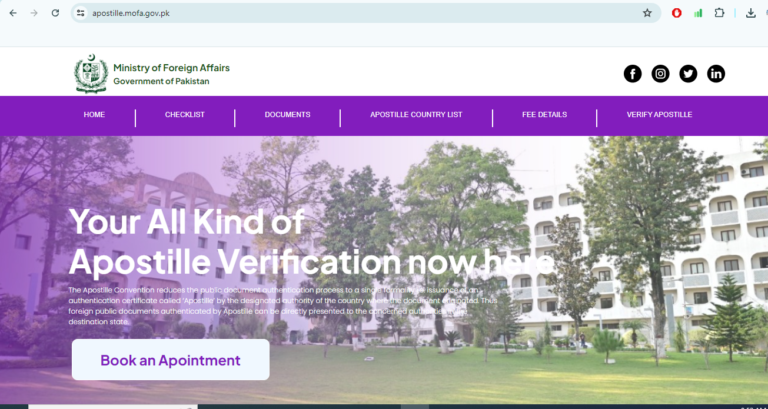
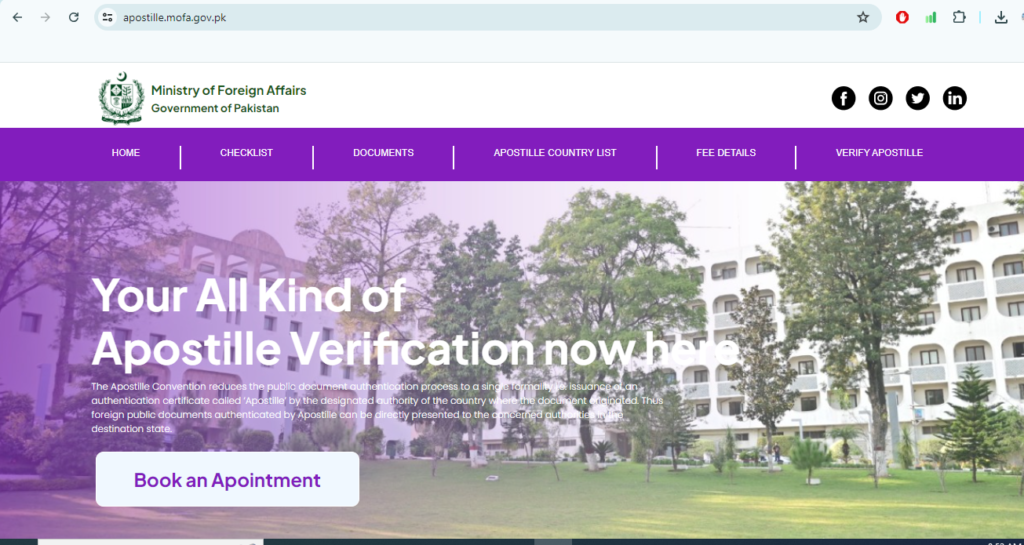
Starting from 8th July, 2024, Mofa has started apostille verification of documents using Tcs and other courier services. Now you can send your documents through Tcs for apostille verification in Pakistan.
Use Tcs For Apostille Verification of Documents Pakistan
To Get Apostille Verification through Tcs Link Visit Below:
Now get apostille verification of documents in Pakistan using Tcs. Designated Courier services will collect your document and than send it to Ministry of Foreign Affairs MOFA for apostille verification. the courier services designated including Tcs are listed below.
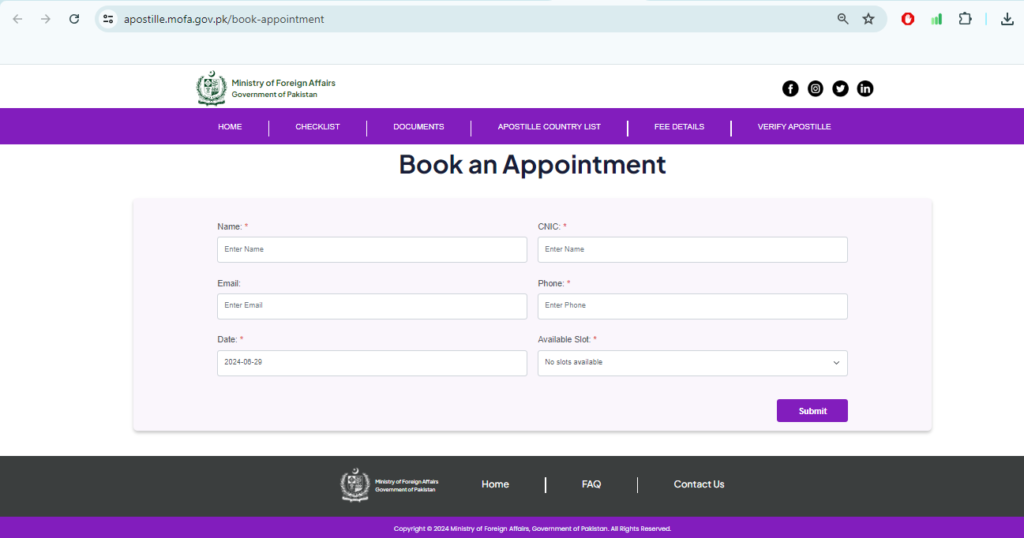
MOFA Appointment
To book an appointment for physically visiting and getting your documents verified from ministry of foreign affairs Pakistan please use the link below.
Click on Book Appointment and you will Get the Form Fill it carefully and get the appointment.
To get apostille verification using courier services from Pakistan use below mentioned information.
Launch of Apostille Legalization Verification Process through Tcs courier services
The Ministry of Foreign Affairs and its liaison offices at Lahore and Karachi will be starting the Apostille legalization process via walk-in applicants, to facilitate the general public, effective from Monday, 08 July 2024. No appointments are required.
Five courier companies have been hired for provision of Apostille legalization to the general public at their door steps. The following authorized courier companies will charge their service charges in addition to fees of Apostille Certification:
Gerry’s International Pvt. Ltd.
Leopards Courier Service Pvt. Ltd.
Excellent Courier Services (ECS)
M&P Express Logistics Pvt. Ltd.
TCS Pvt. Ltd.
The fee structure for Apostille Certification has also been revised with effect from 08 July 2024. The new fee structure is as follows:
1. Personal and Educational Documents – Rs. 3,000/- per document
2. Legal Documents – Rs. 4,500/- per document
3. Commercial Documents – Rs. 12,000/- per document
Complaint:
In case of any complaint against Mofa or anyother government department, their is Federal ombudsman (wafaqi mohtasib) وفاقی محتسب سیکر ٹیر یٹ for redressal. Read
MOFA and Camp Offices will remain open for consular services during the following hours:
Monday to Thursday – 7:30 am to 1:00 pm Friday – 7:30 am to 12:00 pm
Token Will be Issued Only During The Following Timings:
Monday to Friday – 7:30 am to 10:00 am
For Queries Related to Consular Service: Please Contact at:
051-90569524 – Monday to Friday – 8 am to 4 pm
For Apostille verification of documents through Tcs Visit below link:
Visit Below link for Apostille Verification booking through Tcs
ایران اور امریکہ نے گیارہ جون دو ہزار چھبیس کو جنیوا میں ایک تاریخی جنگ بندی معاہدے پر دستخط کر دیے — یہ معاہدہ مئی دو ہزار چھبیس میں شروع ہونے والی اس خونریز جنگ کا خاتمہ ہے جو جدید تاریخ میں ان دونوں ممالک کے درمیان پہلی براہِ راست فوجی تصادم تھی۔
پسِ منظر: مئی دو ہزار چھبیس کی جنگ
کشیدگی اس وقت اپنے عروج پر پہنچی جب مئی دو ہزار چھبیس کے اوائل میں امریکہ نے اسرائیل کے ساتھ مل کر ایران کی جوہری تنصیبات — فردو، نطنز اور اصفہان — پر زبردست فضائی حملے کیے۔ ایران نے بھرپور جوابی کارروائی کرتے ہوئے قطر اور عراق میں امریکی اڈوں پر بیلسٹک میزائل داغے اور اسرائیلی علاقوں پر ڈرون حملے کیے۔ یہ جنگ بائیس روز تک جاری رہی، جس کے بعد چین، روس اور اقوامِ متحدہ کی سلامتی کونسل کی مشترکہ سفارتی کوششوں نے دونوں فریقوں کو مذاکرات کی میز پر لا بٹھایا۔
معاہدے کی اہم شرائط
فوری جنگ بندی: گیارہ جون دو ہزار چھبیس کو رات بارہ بجکر ایک منٹ جی ایم ٹی پر تمام فوجی کارروائیاں مکمل طور پر بند کر دی گئیں۔
جوہری پروگرام کی معطلی: ایران نے کم از کم پانچ برس کے لیے یورینیم افزودگی مکمل طور پر روکنے پر رضامندی ظاہر کی، جبکہ آئی اے ای اے کے معائنہ کاروں کو تمام جوہری مقامات تک غیر محدود رسائی دی جائے گی۔
امریکی پابندیوں کا خاتمہ: واشنگٹن نے معاہدہ نافذ ہونے کے پینتالیس روز کے اندر ایران کے تیل، بینکاری اور تجارت پر عائد تمام ثانوی پابندیاں اٹھانے کا عہد کیا۔
قیدیوں کا تبادلہ: دونوں ممالک نے پندرہ دنوں کے اندر جنگ کے دوران گرفتار تمام فوجی اور سویلین قیدیوں کو رہا کرنے پر اتفاق کیا۔
حکومت تبدیلی کی یقین دہانی نہیں: امریکہ نے باقاعدہ اعلان کیا کہ وہ ایران کی حکومت کو تبدیل کرنے کی کسی بھی کوشش میں نہ حصہ لے گا اور نہ کسی کی معاونت کرے گا — یہ ایران کا سب سے اہم مطالبہ تھا۔
تعمیرِ نو کا فنڈ: یورپی یونین اور خلیجی ممالک کی مشترکہ سرپرستی میں دس ارب ڈالر کا ایک بین الاقوامی فنڈ قائم کیا جائے گا جو ایران کی تباہ شدہ شہری تعمیرات کی بحالی کے لیے استعمال ہوگا۔
دستخطی تقریب
معاہدے پر دستخط کی تقریب گیارہ جون دو ہزار چھبیس کو جنیوا، سوئٹزرلینڈ میں منعقد ہوئی جہاں اقوامِ متحدہ کے سیکرٹری جنرل انتونیو گوتیرش بطور گواہ موجود رہے۔ امریکی وزیرِ خارجہ مارکو روبیو اور ایرانی وزیرِ خارجہ عباس عراقچی نے اپنی اپنی حکومتوں کی جانب سے دستخط کیے۔
عالمی ردِّعمل
دنیا بھر کے رہنماؤں نے اس معاہدے کو خوش آمدید کہا۔ پاکستان کی دفترِ خارجہ نے اسے ”خطے کے استحکام کے لیے سکون کا پیغام” قرار دیا جبکہ سعودی عرب اور متحدہ عرب امارات نے احتیاطی امید کا اظہار کیا۔ اسرائیلی وزیرِ اعظم بینجمن نیتن یاہو نے جنگ بندی کو تسلیم تو کیا، مگر ساتھ ہی خبردار کیا کہ اگر ایران نے دوبارہ جوہری سرگرمیاں شروع کیں تو اسرائیل ”آزادانہ طور پر اقدام کرنے کا حق محفوظ رکھتا ہے۔” عالمی تیل کی منڈیوں میں اس خبر کے بعد چھ فیصد سے زائد گراوٹ آئی اور برینٹ خام تیل چوہتر ڈالر فی بیرل تک آ گیا۔
آگے کیا ہوگا؟
بیس جولائی دو ہزار چھبیس کو جنیوا میں ایک اور سفارتی اجلاس طے ہے جس میں ایک مستقل جوہری معاہدے کے مذاکرات کا آغاز کیا جائے گا۔ امریکی سینیٹ اور ایران کی سپریم نیشنل سیکیورٹی کونسل کو موجودہ معاہدے کی توثیق تیس دنوں کے اندر کرنا ہوگی تاکہ یہ مکمل قانونی حیثیت اختیار کر سکے۔ تجزیہ کاروں کا کہنا ہے کہ یہ معاہدہ، خواہ کتنا ہی نازک کیوں نہ ہو، انیس سو اناسی کے اسلامی انقلاب کے بعد امریکہ اور ایران کے تعلقات میں سب سے بڑی تبدیلی کی نمائندگی کرتا ہے۔
Iran and the United States have signed a ceasefire and diplomatic agreement on June 11, 2026, ending weeks of direct military conflict that erupted in May 2026 — the first open war between the two nations in modern history.
Background: The May 2026 War
Hostilities broke out in early May 2026 after the United States, alongside Israel, launched a series of airstrikes targeting Iran’s nuclear facilities at Fordow, Natanz, and Isfahan. Iran retaliated with ballistic missile strikes on US bases in Qatar and Iraq and launched drone attacks against Israeli territory. The conflict lasted approximately 22 days before international pressure — led by China, Russia, and the UN Security Council — forced both parties to the table.
The June 11 Agreement: Key Terms
Immediate ceasefire: All military operations ceased effective 00:01 GMT on June 11, 2026.
Nuclear programme suspension: Iran agreed to a full suspension of uranium enrichment for a minimum of 5 years, with IAEA inspectors granted unrestricted access to all sites.
US sanctions lifted: Washington agreed to lift all secondary sanctions on Iranian oil, banking, and trade within 45 days of the agreement taking effect.
Prisoner exchange: Both nations agreed to release all military and civilian detainees captured during the conflict within 15 days.
No regime change clause: The US formally pledged not to pursue or support any effort to change Iran’s government — a key Iranian demand.
Reconstruction fund: A joint international fund of $10 billion, co-sponsored by the EU and Gulf states, will support reconstruction of damaged Iranian civilian infrastructure.
Signing Ceremony
The agreement was signed in Geneva, Switzerland on June 11, 2026, witnessed by UN Secretary-General António Guterres. US Secretary of State Marco Rubio and Iranian Foreign Minister Abbas Araghchi signed on behalf of their respective governments.
Global Reaction
World leaders broadly welcomed the deal. Pakistan’s Foreign Office issued a statement calling it “a relief for regional stability,” while Saudi Arabia and the UAE expressed cautious optimism. Israel’s Prime Minister Benjamin Netanyahu acknowledged the ceasefire but said Israel “reserves the right to act independently” if Iran resumes nuclear activity. Oil prices fell over 6% on the news, with Brent crude dropping to $74 per barrel.
What Comes Next
A follow-up diplomatic summit is scheduled for July 20, 2026 in Geneva to begin negotiating a permanent nuclear treaty. The US Senate and Iran’s Supreme National Security Council must both ratify the current agreement within 30 days for it to take full legal effect. Analysts say the deal, while fragile, represents the most significant shift in US-Iran relations since the 1979 Islamic Revolution.
Pakistan’s automobile sector is on the verge of its biggest policy reset in a decade. The draft Auto Industry Development and Export Policy (AIDEP) 2026–31 — officially expected to take effect from July 1, 2026 — is currently being vetted by a special committee formed by the Prime Minister. Once cleared by the Federal Cabinet and tabled in Parliament, it will redefine how cars are made, priced, financed, and imported in Pakistan for the next five years.
This complete guide covers everything Pakistani car buyers, investors, and industry stakeholders need to know about the new auto policy — from lower import duties and EV incentives to used-car reforms, consumer protections, localization targets, and key highlights of Budget 2026–27 for the automobile sector.
What Is the Pakistan Auto Policy 2026–31?
The Pakistan Auto Policy 2026–31 is the successor to the AIDEP 2021–26, which expires in June 2026. The new draft policy is formally titled the Automobiles and Auto Parts Manufacturing Policy 2026–31 and has been developed in close coordination with the Engineering Development Board (EDB) and the Ministry of Industries and Production.
Key goals of the new auto policy include:
Shifting from protection-based assembly to performance-based manufacturing
Reducing import tariffs gradually over five years
Aggressively promoting New Energy Vehicles (NEVs) to reach 30% adoption by 2030
Regulating commercial used-vehicle imports through formal channels
Increasing domestic value addition in complex auto parts like engines and transmissions
Opening Pakistan’s auto market to meaningful, healthy competition
As of June 2026, Finance Minister Muhammad Aurangzeb confirmed the policy is being reviewed by the PM’s special committee. Deputy PM Ishaq Dar also reviewed the policy (June 2026), backing faster EV adoption to boost jobs, exports, and climate action.
Pakistan’s Auto Sector Today: The Starting Point
118 OEMs and assemblers operating in Pakistan — a dramatic expansion from the old “Big Three” Japanese brands era
Over 90% localization achieved in two-wheelers and three-wheelers
Passenger car localization remains at around 50%, mostly in low-value parts like seats and wiring harnesses
Complex parts — engines, transmissions, battery systems — still heavily imported
The industry receives Rs. 285.2 billion in annual customs duty concessions (57% of all national customs concessions)
Global EV leader BYD (China) investing approximately $150 million to establish local EV production in Pakistan
Pakistan currently exports virtually no finished vehicles — a key gap the new policy targets
Key Features of the Auto Policy 2026–31
1. Phased Reduction in CBU Import Duties
The policy proposes a phased reduction in customs duties on Completely Built-Up (CBU) vehicles imported to Pakistan. By 2030, the proposed duty structure will be:
Engine Category
Current Duty
Proposed Duty by 2030
850cc and below
56%
35%
851cc – 1000cc
71%
40%
1001cc – 1500cc
76%
45%
1501cc – 1800cc
91%
77%
1801cc and above
156%
115%
These are phased reductions, not overnight price cuts. The draft also plans to eliminate Additional Customs Duties (ACD), reduce Regulatory Duties by 80%, bring the weighted average tariff below 6%, and phase out Special Regulatory Orders (SROs) by 2030 in favor of a transparent tariff-based system.
2. Major NEV (Electric Vehicle) Incentives
The 2026–31 Auto Policy gives NEVs — Battery Electric Vehicles (BEVs), Plug-in Hybrids (PHEVs), Range-Extender EVs (REEVs), and Fuel Cell EVs (FCEVs) — the most generous incentive package Pakistan has ever offered. The government’s target is 30% NEV adoption by 2030.
Vehicle Type
Tax Treatment
Locally assembled NEVs
1% Sales Tax (vs 18% standard)
Conventional petrol vehicles
18% Sales Tax (GST)
Hybrid vehicles
9% Sales Tax
NEV-specific parts
1% customs duty (3 years), then 5%
All NEVs
Exempt from FED, CVT, and WHT
Budget 2026–27 confirmed EV tax relief is extended for locally assembled EVs. However, luxury imported EVs priced above Rs. 20 million face a new 30–40% FED to focus incentives on mass-market adoption.
3. L6 and L7 Vehicles — Pakistan’s New Affordable Urban Category
The draft introduces the L6/L7 vehicle category — lightweight urban vehicles positioned between motorcycles and traditional small cars. Targeting a price of Rs. 1.5–2 million, these vehicles address the mobility gap between a 70cc motorcycle and a Rs. 3 million+ small car.
Policy support for L6/L7 vehicles:
1% Sales Tax (vs standard 18% GST)
Waiver of mandatory ED Paint facility requirement
Concessionary CBU imports at 10% customs duty for 200 units per variant until June 30, 2028
Partial subcontracting allowed for assembly
4. Regulated Commercial Used-Car Imports
The draft allows commercial used-vehicle imports through a formal regulated framework. Importers must have Rs. 350 million+ in capital, after-sales service networks, and pass mandatory WP-29 UNECE safety inspections. Used vehicle duties start at 40% above new CBU rates in FY2026, gradually equalizing by 2030. Maximum depreciation is capped at 30% even for vehicles up to 50 years old.
5. Consumer Protections — Booking Prices and Delivery Penalties
The most buyer-friendly provisions in the 2026–31 policy directly address Pakistan’s notorious car market problems:
Booking prices locked — no arbitrary hikes after order confirmation
Delivery beyond 30 days triggers automatic compensation at KIBOR + 3%
OEMs must report bookings held beyond 60 days to EDB monthly
Dealer parts markup capped at 20% above OEM purchase price
Warranty responsibility squarely on OEMs and authorized importers
6. Relaxed Auto Financing
In collaboration with SBP, the draft proposes extending auto loan tenure to 7 years (from 5), reducing minimum down payment to 15% (from 20–30%), and raising the loan cap to Rs. 10 million, initially for tractors, NEVs, and vehicles below 1800cc.
7. Localization Targets for 2031
Vehicle Segment
2025 Baseline
2028 Target
2031 Target
Small cars (below 1000cc)
60%
70%
80%
Mid-range cars
35–45%
50%
60%
SUVs
20–30%
45%
55%
Heavy commercial vehicles
25–40%
50%
60%
Electric vehicles (cars)
Below 10%
30%
50%
EV 2-wheelers & 3-wheelers
~50%
70%
85%
Budget 2026–27: Auto Sector Key Decisions
New Taxes on Large and Luxury Vehicles
Imported vehicles 2,000cc–3,000cc: 40% FED
Imported vehicles above 3,000cc: 41% FED
Vehicles priced Rs. 20–30 million: 30% SED
Vehicles priced above Rs. 30 million: 40% SED
New carbon levy up to 19.5% on large combustion-engine vehicles
Rs. 285 Billion in Customs Concessions for Auto Industry
OEMs (assemblers): Rs. 219.6 billion
Vendors (parts makers): Rs. 41.7 billion
CKD & EV parts: Rs. 23.9 billion
Total: Over 57% of all national customs concessions
Who Wins and Loses Under Auto Policy 2026–31?
Winners
Car buyers — More choice, competitive prices, locked booking prices, and delivery accountability
EV and hybrid buyers — 1% sales tax, duty exemptions, and growing EV ecosystem
New OEM entrants — Easier market access, reduced SRO gatekeeping
BYD Pakistan and Chinese EV makers — Policy perfectly aligned with their expansion plans
Formal used-car importers — A legitimate, regulated commercial import pathway
Losers
Legacy assemblers dependent on tariff walls — SRO protection phased out by 2030
Grey-market used-car importers — Strict capital and compliance requirements
Luxury vehicle buyers — Dramatically higher FED and carbon levies from July 2026
Local vendors (if used imports aren’t carefully managed) — Risk of Rs. 60 billion annual displacement
Frequently Asked Questions (FAQs)
When does Pakistan Auto Policy 2026 take effect?
The new Auto Policy 2026–31 is expected to officially launch on July 1, 2026, following final Cabinet approval. As of June 17, 2026, it is still in final vetting by the PM’s special committee.
Will car prices in Pakistan go down in 2026?
Not immediately. The phased tariff reductions and regulated used imports will create competitive pressure over 1–3 years. However, inflation and exchange rates will continue to influence showroom prices in the short term.
What is the EV sales tax in Pakistan 2026?
Locally assembled NEVs are subject to 1% sales tax under the 2026–31 policy (confirmed in Budget 2026–27). Hybrid vehicles face 9%. Imported EVs priced above Rs. 20 million face 30–40% FED.
Can I commercially import used cars to Pakistan from 2026?
Yes, under a formal regulated framework. Commercial importers must meet strict capital (Rs. 350 million+), after-sales service, inspection, and safety compliance requirements. Initial duties are 40% above new CBU rates, phasing down toward parity by 2030.
What are L6 and L7 vehicles?
L6/L7 are a new lightweight urban vehicle category smaller than conventional cars but larger and safer than three-wheelers. They are expected to be priced at Rs. 1.5–2 million with 1% sales tax, designed to bridge Pakistan’s motorcycle-to-car mobility gap.
What is Pakistan’s EV adoption target by 2030?
The Auto Policy 2026–31 sets a target of 30% NEV adoption by 2030, with 85% domestic value addition in EV two-wheelers and three-wheelers (batteries, motors, controllers) by 2030.
Conclusion
Pakistan’s Auto Policy 2026–31 is the most ambitious, buyer-centric automotive reform framework the country has seen in a decade. It correctly identifies structural problems — over-protection of assemblers, weak localization of complex parts, near-zero exports, and a market that has consistently failed consumers. The draft creates a genuine framework for change: phased tariff cuts, strong NEV incentives, regulated used imports, locked booking prices, and real delivery penalties.
But Pakistan has seen bold policy announcements before. The critical test will be whether the Engineering Development Board actually enforces localization benchmarks, whether tariff savings reach consumers instead of being absorbed as OEM profits, and whether the consumer protection rules survive contact with powerful industry lobbies.
Stay with PakCitizenGuide.com for live updates as the policy officially launches from July 1, 2026.
Disclaimer: This article is based on the draft Auto Policy 2026–31 and Budget 2026–27 announcements as of June 17, 2026. Final policy details are subject to Cabinet approval and official Gazette notification.
If you are planning to import a Japanese car to Pakistan in 2026, one of the most critical steps is verifying the model year of the vehicle. Many buyers get deceived by sellers who misrepresent the manufacture year, leading to customs problems, higher duties, and fraud. This guide explains exactly how to check the manufacture year and model number of any Japanese car — completely free — using your chassis or frame number.
Why Verifying the Japanese Car Model Year Matters in 2026
Pakistan’s import policy for used vehicles is directly tied to the year of manufacture. Under current SRO regulations, only cars up to a certain age are allowed to be imported. A wrong or fraudulent manufacture year on the auction sheet can result in your vehicle being held at customs, face additional levies, or even be rejected entirely. In 2025–2026, the Pakistan customs authority has tightened scrutiny of import documents, making independent verification of the Japanese car chassis number and model year more important than ever.
Beyond legal compliance, knowing the exact manufacture year also protects you from overpaying. A seller listing a car as a 2022 model when it was actually manufactured in late 2019 can make a difference of hundreds of thousands of rupees in resale value and market price.
What is a Chassis Number (Frame Number) in Japanese Cars?
Unlike Western countries that use a standardized 17-digit VIN (Vehicle Identification Number), Japan uses a Chassis Number — also called a Frame Number. It typically contains 9 to 12 alphanumeric characters and is structured as a model code + serial number. For example:
ZZE122-1234567 — Toyota Corolla (ZZE122 = model code, 1234567 = serial)
NHP10-1234567 — Toyota Aqua / Prius C
DAA-GP5-1234567 — Honda Fit Hybrid
E12-123456 — Nissan Note
HA36S-123456 — Suzuki Alto (Japan spec)
This chassis number is stamped on the firewall, door frame, or dashboard of the vehicle, and is also printed on the auction sheet and the Japanese export certificate. It is the single most important identifier for verifying any Japanese car’s history, model, and manufacture year.
How to Check Japanese Car Model Year Free Online — Using OLIAC
The fastest and most reliable free tool to verify the year of manufacture of any Japanese car using a chassis or frame number is OLIAC Japan. OLIAC is a Japan-based quality vehicle exporter platform that maintains a comprehensive database of Japanese car production records dating from 1984 all the way to 2025. It is one of the most referenced tools on Pakistani car forums including PakWheels for confirming the actual production year of imported vehicles.
Step-by-Step: How to Use OLIAC to Verify Japanese Car Model Year
Visit oliac.com — the official OLIAC Japan website.
Navigate to the Year of Manufacture / Frame Number Lookup section.
Enter your vehicle’s chassis number or frame number in the search box (e.g., ZZE122-1234567 or just the serial portion 1234567).
Click Search.
The tool instantly returns the confirmed year of manufacture for that specific Japanese vehicle.
The OLIAC database covers all major Japanese manufacturers including Toyota, Honda, Nissan, Suzuki, Daihatsu, Mitsubishi, Subaru, Mazda, and Isuzu. It is completely free to use and requires no registration. Note: month of production is not available through this tool — only the year of manufacture is returned.
Pro Tip: Always cross-check the year returned by OLIAC against what is written on the seller’s auction sheet and export certificate. Any mismatch is a red flag and should be investigated before completing any purchase or customs declaration in Pakistan.
Most Popular Japanese Import Cars in Pakistan 2026 — Model Year Check Guide
Based on current market trends and PakWheels search data for 2026, these are the top Japanese cars being imported to Pakistan, along with their typical chassis code prefixes you can use on OLIAC to verify the manufacture year:
Year mismatch: OLIAC shows a different manufacture year than the auction sheet or seller’s claim.
Odometer rollback: Suspiciously low mileage on an older-year car — verify against auction sheet grade and mileage record.
Chassis number mismatch: The number on the car body differs from the export certificate or auction sheet.
Missing auction sheet: A legitimate Japanese export should always come with an original auction grading report.
No export certificate: Without an MLIT-issued export cert, the car cannot be legally registered in Pakistan.
Price too good to be true: If a claimed 2022 model is priced like a 2017 model, always verify the actual manufacture year on OLIAC before paying.
Pakistan Import Age Restriction for Japanese Cars (2026)
Under Pakistan’s current vehicle import policy, used cars imported under personal baggage or transfer of residence schemes must generally be not older than 3 years from the year of manufacture at the time of import. For 2026, this means most importable vehicles should be 2023 model year or newer for standard channels, though specific SRO categories exist for older models under certain conditions. Always confirm with a licensed customs clearing agent before finalising a purchase, as FBR policies are updated periodically.
This is precisely why verifying the exact manufacture year via the chassis number on OLIAC is a non-negotiable step before importing any Japanese vehicle to Pakistan in 2026.
Frequently Asked Questions
Is OLIAC free to use for checking Japanese car manufacture year?
Yes. OLIAC Japan offers a completely free chassis number to manufacture year lookup. No registration or payment is required. It covers vehicle data from 1984 to 2025.
Can I check the manufacture month too?
No. OLIAC provides year of manufacture only. The month of production is not available. For month verification, refer directly to the auction sheet or Japanese export certificate.
What if OLIAC returns no result for my chassis number?
This can happen if the vehicle data is outside the 1984–2025 range, or if the chassis number was entered incorrectly. Double-check the number physically on the car or on the auction sheet and try again.
What is the difference between chassis number and VIN?
Japanese cars use a Chassis Number (Frame Number) rather than the 17-digit international VIN standard used in the US and Europe. When importing to Pakistan, both terms are used interchangeably in official customs documents.
Which Japanese cars are most popular for import to Pakistan in 2026?
The most searched and imported Japanese cars in Pakistan in 2026 are: Toyota Aqua, Honda Vezel, Nissan Note e-Power, Toyota Corolla Axio, Toyota Vitz, Daihatsu Mira, Honda Fit Hybrid, Toyota Prius, Toyota Raize, and Suzuki Alto (Japan spec). All can have their manufacture year verified free on OLIAC.
Final Checklist Before Importing a Japanese Car to Pakistan
Get the full chassis / frame number from the seller, auction sheet, or export certificate.
Verify the manufacture year for free on OLIAC Japan.
Cross-check the confirmed year against the auction sheet, export certificate, and bill of lading.
Confirm the car falls within Pakistan’s current import age limit (typically up to 3 years old for personal import in 2026).
Get the auction sheet independently verified.
Hire a licensed customs clearing agent for FBR / Web-IV declarations.
Collect all original documents before paying the full amount to any seller.
By following these steps — especially using the free OLIAC chassis number year lookup — you can protect yourself from fraud and ensure a smooth customs clearance when importing a Japanese car to Pakistan in 2026.
For more guides on car import procedures, customs duty calculations, and vehicle verification in Pakistan, bookmark PakCitizenGuide.com — your trusted resource for citizen information in Pakistan.
A Police Character Certificate (PCC) — also known as a Character Certificate from Police or Criminal Record Certificate — is an essential document for Pakistanis seeking overseas employment, immigration, higher education abroad, visa applications, and even some government jobs at home. In 2026, the process has been made more accessible in several provinces with online application options available. This complete guide will walk you through everything you need to know about getting a Police Character Certificate in Pakistan.
What is a Police Character Certificate?
A Police Character Certificate is an official document issued by the Pakistan Police (or NADRA in partnership) confirming that the applicant has no criminal record in Pakistan. It verifies that the person has not been convicted of any crime under Pakistani law. It is also called a Good Conduct Certificate or Police Clearance Certificate (PCC) in some contexts.
When Do You Need a Police Character Certificate in Pakistan?
You will typically need a Police Character Certificate in the following situations:
Overseas Employment: Required by most countries (UAE, Saudi Arabia, UK, Canada, Australia, etc.) when applying for a work visa or residence permit
Immigration / PR Applications: Canada, Australia, and European countries require a PCC from your home country
Student Visa Applications: Many countries require it for student visa applications
Government Jobs in Pakistan: Some departments require it during background verification
Embassy / Visa Applications: Many embassies require a PCC as part of the visa documentation
Professional Licensing Abroad: Medical, engineering, and other professional bodies abroad may require it
Types of Police Character Certificates in Pakistan
There are two main types depending on your need:
Local Police Character Certificate: Issued by the local police station or SP/DIG office for domestic purposes (job applications, admissions, etc.)
NADRA Police Character Certificate (for Overseas/Immigration): A digitally signed, internationally recognized certificate issued through NADRA in coordination with the police — this is what is required for overseas immigration, work visas, and embassy use
How to Get a NADRA Police Character Certificate (Overseas / PCC) 2026
For overseas immigration, work visas, and embassy submissions, you need the NADRA Police Character Certificate. This is a digitally signed, verifiable certificate with a QR code. Here is the complete process:
Step 1: Apply Online via Pak Identity Portal
Go to id.nadra.gov.pk (Pak Identity Portal). Register or log in with your CNIC. Navigate to the Police Character Certificate service. Fill in the application form with your personal details, purpose of the certificate, and country of destination.
Step 2: Pay the Fee Online
Pay the fee online through the portal using debit/credit card or mobile banking. The fee for NADRA Police Character Certificate in 2026 is PKR 1,500 to PKR 2,000 depending on the processing tier chosen. An expedited option is available for an additional charge.
Step 3: Police Verification
After your application is submitted, your local police station conducts a background check. A police officer may visit your registered home address for verification, or verification may be done through NADRA records. This step takes approximately 7 to 21 working days.
Step 4: Receive Your Certificate
Once verification is complete, your Police Character Certificate will be digitally generated and can be downloaded from the Pak Identity portal. You can also opt for a printed version to be sent by courier to your address. The certificate includes a unique QR code that can be scanned by international authorities to verify its authenticity.
How to Get a Local Police Character Certificate (From Police Station) 2026
For domestic purposes (local job applications, university admissions, etc.), you can get a character certificate directly from your local police station. Here is the process:
Step 1: Visit your local police station (the one covering your home address as per CNIC)
Step 2: Speak to the SHO (Station House Officer) or the officer handling character certificates
Step 3: Fill out the character certificate application (available at the station)
Step 4: Attach a copy of your CNIC and two passport-size photographs
Step 5: A local police officer may visit your home for verification
Step 6: Return to the police station after 3–7 days to collect your signed certificate
Fee for local certificate: There is no official government fee for local police character certificates. However, a nominal amount may be charged for stamps. Avoid paying large bribes — if asked for unreasonable money, complain to the SP (Superintendent of Police) office directly.
Required Documents for Police Character Certificate Pakistan 2026
Original CNIC + photocopy
Passport (if applying for overseas PCC) — original + photocopy of bio-data page
Passport-size photographs (2–4)
Application form (available at police station or online on NADRA portal)
Purpose letter or employment offer letter (for overseas applications)
Police Character Certificate Fees in Pakistan 2026
NADRA Online PCC (Normal processing): PKR 1,500 to PKR 2,000
NADRA Online PCC (Expedited/Urgent): PKR 3,000 to PKR 4,000
Local Police Station Certificate: Officially free (small stamp charges may apply)
Courier delivery option: Additional PKR 200–500
How to Get Your Police Character Certificate Attested for Overseas Use
If your certificate is for use in another country, it will likely need to be attested. Here is the complete attestation chain for a Pakistani Police Character Certificate:
Step 1 — NADRA Attestation: For NADRA-issued digital PCC, this step may be skipped as it already carries a digital signature
Step 2 — Ministry of Foreign Affairs (MOFA) Attestation: Get the certificate attested by MOFA Pakistan at their offices in Islamabad, Lahore, Karachi, Peshawar, or Quetta. Fee: PKR 1,000–2,000 per document. You can also use the MOFA online attestation service at mofa.gov.pk.
Step 3 — Embassy Attestation: Get the MOFA-attested certificate further attested by the embassy of the destination country in Pakistan (e.g., UAE Embassy, Saudi Consulate, Canadian High Commission)
Step 4 — Apostille (if required): Pakistan joined the Hague Apostille Convention in 2023. For countries that accept Apostille, you can get an Apostille stamp from MOFA instead of embassy attestation — check if your destination country accepts Apostille.
Online Punjab Police Character Certificate 2026
Punjab Police has its own online portal for character certificates through the Punjab Police e-Services platform. Punjab residents can apply at punjabpolice.gov.pk for a local character certificate online, track its status, and receive it via courier. This eliminates the need to visit the police station and is a great convenience for Punjab residents in 2026.
Processing Time for Police Character Certificate in Pakistan 2026
NADRA Online PCC (Normal): 7–21 working days
NADRA Online PCC (Urgent): 3–5 working days
Local Police Station PCC: 3–10 working days
Punjab Police Online: 5–15 working days
Frequently Asked Questions — Police Character Certificate Pakistan 2026
What is the validity of a police character certificate in Pakistan?
Typically, a Police Character Certificate is valid for 6 months from the date of issue. Many embassies and employers require it to have been issued within the last 3–6 months, so always obtain a fresh one close to your application date.
Can I get a police character certificate if I have a minor traffic offense or old case?
Minor traffic violations (challan) do not appear on the criminal record and will not affect your character certificate. However, if you have been convicted of a criminal offense, arrested, or have an ongoing FIR/case, this may appear in the police records. In such cases, consult a lawyer before applying, especially if the certificate is for immigration purposes.
Can overseas Pakistanis get a PCC from outside Pakistan?
Yes. Overseas Pakistanis can apply for a NADRA Police Character Certificate through the Pakistan Embassy or Consulate in their country of residence. Contact your nearest Pakistani embassy for the process, fees, and required documents specific to your location.
Is the NADRA character certificate accepted by foreign embassies?
Yes, the NADRA Police Character Certificate (after MOFA attestation and embassy attestation if required) is accepted by foreign embassies, immigration departments, and employers worldwide. Its QR code verification feature makes it easy to authenticate internationally.
Conclusion
Getting a Police Character Certificate in Pakistan in 2026 is a straightforward process, especially with the NADRA online system and Punjab Police’s digital services. For overseas use, apply through the NADRA Pak Identity portal for a digitally signed, internationally verifiable certificate, then get it attested by MOFA and the relevant embassy. For domestic purposes, your local police station or Punjab Police online portal can issue one quickly and at minimal cost. For more guides on Pakistani government services, immigration, legal documents, and citizen rights, visit PakCitizenGuide.com — your trusted guide for Pakistani citizens.
Property fraud is one of the most serious issues facing Pakistani citizens, especially in Punjab. In 2026, the Punjab Land Records Authority (PLRA) has made it significantly easier to verify property ownership and land records online, protecting buyers and sellers from fraud. Whether you are buying property, checking inheritance records, or verifying ownership before a transaction, this guide will walk you through exactly how to use the PLRA Arazi Portal to check property records in Punjab.
What is the PLRA Arazi Portal?
The Punjab Land Records Authority (PLRA) manages all computerized land records in Punjab through its digital platform called the Arazi Portal (arazi.punjab.gov.pk). This portal contains digitized records of millions of land parcels across Punjab, including ownership details, mutation history, and land area measurements. It replaced the old paper-based Patwari system for land record verification and allows any citizen to check property records from anywhere in the world.
What Information Can You Find on the PLRA Portal?
The PLRA Arazi portal provides access to the following land record information:
Fard Malkiat (Ownership Record): Official document confirming who legally owns a piece of land
Khasra Number: The unique identification number assigned to each piece of agricultural/urban land
Khewat Number: The owner’s account number in the land revenue record
Khatooni Number: The register number linking a landowner to their land parcels
Mutation Details (Intiqal): History of ownership transfers and changes
Land Area: Total area of the plot in Kanals, Marlas, or square feet
Land Classification: Whether the land is agricultural, residential, commercial, etc.
How to Check Property Records Online in Punjab 2026 — Step by Step
Method 1: Using the PLRA Arazi Web Portal
Follow these steps to check property records online using the official Punjab land records portal:
Step 1: Open your browser and go to arazi.punjab.gov.pk
Step 2: Click on “Fard” or “View Land Record” option on the homepage
Step 3: Select your Province (Punjab), District, Tehsil, and Village/Mouza from the dropdown menus
Step 4: Select the type of record you want to search by: Khasra Number, Khewat Number, Khatooni Number, or Owner Name
Step 5: Enter the relevant number or name in the search box
Step 6: Click “Search” — the land record details will be displayed on screen
Step 7: You can view the record online for free, or pay a small fee to download an official Fard (certified copy)
Method 2: Using the Arazi Record Centers (ARC)
If you need a legally certified printed copy of your Fard (official ownership document), you can visit any Arazi Record Center (ARC) in Punjab. There are over 2,000 Arazi Record Centers operating across Punjab at the tehsil level. At the ARC, you can:
Request a printed Fard with official stamp (fee: PKR 250–500)
Verify ownership records in person with staff assistance
Apply for mutation (Intiqal) for property transfer
Request copies of historical land records
Method 3: Using the Punjab Land Records Mobile App
In 2026, PLRA also offers a mobile application called “Zameen Punjab” available on Android and iOS. The app allows you to search land records, check ownership, and locate your nearest ARC center from your smartphone. Download it from the Google Play Store or Apple App Store by searching “Zameen Punjab PLRA.”
Key Terms You Need to Know Before Checking Property Records
Khasra Number: A survey number assigned to individual plots of land. Think of it as the plot’s unique ID. To search records, you need the Khasra number of the property.
Khewat Number: The account number of the landowner in the village/mouza land register. One Khewat can contain multiple Khasra numbers owned by the same person.
Khatooni Number: The number that identifies the cultivator or holder of the land (who may be different from the owner in case of tenancy arrangements).
Mouza: The name of the revenue village where the land is located. Punjab is divided into thousands of Mouzas.
Fard: The official certified copy of land ownership — the most important document proving who owns a piece of land.
Intiqal (Mutation): The legal process of transferring ownership from one person to another in the land records — must be done to officially complete any property purchase.
How to Get an Official Fard (Certified Ownership Document) in 2026
A Fard is the most critical document when buying or selling property in Punjab. Here is how to get one:
Online Fard
Visit arazi.punjab.gov.pk, search your property record, and use the online payment option to pay the Fard fee (approximately PKR 250–350 via online banking or mobile wallet). The Fard will be generated digitally and can be downloaded. Note: Online Fard is useful for verification but may not be accepted in all legal proceedings — for court cases or official transfers, get a physically stamped Fard from the ARC.
Fard from Arazi Record Center (ARC)
Visit the nearest ARC with your Khasra or Khewat number. Pay the fee (PKR 250–500). The ARC operator will search the records and print an official Fard with a stamp and serial number. This is the legally recognized version of the document.
How to Use Property Records to Protect Yourself from Fraud
Property fraud is alarmingly common in Pakistan. Here is how to use the PLRA portal to protect yourself:
Always get a fresh Fard before buying any property — check that the seller’s name matches the Fard
Check for encumbrances or charges — the Fard will show if the property is mortgaged or has any legal restrictions
Verify the Khasra number matches the physical land being shown to you — fraud often involves showing one plot while selling another’s documents
Check mutation history (Intiqal) to verify the chain of ownership and that previous transfers were legal
Never pay advance money before verifying property records at the PLRA portal
For societies and housing schemes, separately check with LDA (Lahore Development Authority) or relevant city authority that the society is approved
What to Do if Your Name is Missing or Wrong in Land Records?
If you find your name is missing, incorrectly spelled, or the record does not match reality, follow these steps:
Visit your nearest Arazi Record Center (ARC) and speak to the District Officer (Revenue)
Submit a written application with supporting documents (old Fard, sale deed, inheritance documents)
A verification and correction process will be initiated
For disputed records, you may need to file a petition with the Revenue Court at the District level
Contact PLRA helpline: 0800-02345 (toll-free) for complaints and guidance
Frequently Asked Questions — Punjab Property Records 2026
Is the PLRA Arazi portal free to use?
Viewing records online is free. However, downloading or printing an official certified Fard costs a small fee (PKR 250–500). There are no charges for simply searching and viewing records.
Can I check property records for Lahore city plots and houses?
Yes. The PLRA system covers urban as well as rural land in Punjab. However, for plots in housing societies, also verify registration with the Lahore Development Authority (LDA) or the relevant city authority (RDA for Rawalpindi, FDA for Faisalabad, etc.).
What if the property is not found in PLRA records?
If a property does not appear in PLRA records, it could mean: it is located in a housing society that is not yet in the PLRA system, the property is in AJK or tribal areas (which have different systems), or the digitization of that particular Mouza is still in progress. In such cases, verify with the local Patwari office or tehsil revenue office directly.
Can I do property mutation (transfer) online?
In 2026, Punjab has introduced online mutation services through the Arazi portal for certain transaction types. However, most mutations still require an in-person visit to the ARC with original documents. The process includes biometric verification and presence of both buyer and seller at the ARC.
Conclusion
Checking property records online in Punjab has never been easier thanks to the PLRA Arazi portal. Whether you are buying property, verifying inheritance, or protecting yourself from fraud, the arazi.punjab.gov.pk portal gives you instant access to verified land ownership records. Always get a fresh Fard before any property transaction and never skip the verification step. For more guides on property law, government services, legal rights, and citizen services in Pakistan, visit PakCitizenGuide.com — your complete resource for Pakistani citizens.
The United Arab Emirates (UAE) remains one of the top destinations for Pakistani workers in 2026, with hundreds of thousands of Pakistanis employed across Dubai, Abu Dhabi, Sharjah, and other emirates. Whether you are a skilled professional, a technician, or a worker in the construction or hospitality sector, this guide will walk you through everything you need to know about getting a UAE Work Visa from Pakistan in 2026.
Types of UAE Work Visas Available for Pakistanis in 2026
There are several types of UAE employment visas available depending on your job type and employer:
Standard Employment Visa (Work Permit): The most common — sponsored by a UAE employer. Valid for 2 years, renewable.
UAE Green Visa (Self-Sponsored): Launched in 2022 and expanded in 2026, this allows skilled workers and freelancers to live and work in UAE without an employer sponsor for up to 5 years.
UAE Golden Visa: Long-term 10-year visa for highly skilled professionals, investors, and exceptional talent.
Mission Visa: For workers sent on specific projects by Pakistani companies.
Domestic Worker Visa: For housemaids, drivers, cooks, and household staff.
Step-by-Step Process to Get a UAE Work Visa from Pakistan 2026
Step 1: Find a Legitimate Job Offer in UAE
The most important first step is securing a genuine job offer from a UAE employer. You can find verified jobs through:
Rozee.pk — Pakistan’s leading job portal with UAE listings
Bayt.com — Leading Middle East job portal
LinkedIn — Direct applications to UAE companies
OEC-registered recruitment agencies in Pakistan — BEOE (Bureau of Emigration and Overseas Employment) approved agencies
UAE government job portals: Abu Dhabi government portal, Dubai careers
Warning: Beware of fraudulent recruiters. Always verify any recruitment agency is registered with BEOE Pakistan. You can check at beoe.gov.pk. Never pay large sums upfront for a job promise.
Step 2: Employer Applies for Your Work Permit in UAE
Once you have a job offer, your UAE employer will apply for your work permit through the UAE Ministry of Human Resources and Emiratisation (MOHRE). This is done entirely by the employer in UAE — you do not need to do anything at this stage except provide your documents. The employer will apply online at mohre.gov.ae.
Step 3: Receive Your Employment Offer Letter & Contract
Once the work permit is approved, your employer will send you an official Employment Offer Letter and Labour Contract in both English and Arabic. Read the contract carefully before signing — check salary, job title, working hours, accommodation details, and leave entitlement. If anything differs from what you were promised verbally, raise it before signing.
Step 4: Register with BEOE / OEC Pakistan
Before leaving Pakistan for a work visa, you are required to register with the Bureau of Emigration and Overseas Employment (BEOE) and obtain an Emigration Card (OEC — Overseas Employment Contract). This is mandatory for workers going through recruitment agencies and strongly recommended for all overseas workers.
Visit your nearest Protector of Emigrants (PE) office — offices in Lahore, Karachi, Rawalpindi, Multan, Faisalabad, Peshawar, and Quetta
Carry your original passport, job offer letter, employment contract, CNIC, and passport photographs
Fee: PKR 2,000 to PKR 3,000 (official government fee only)
You can also register online at beoe.gov.pk
Step 5: Get Your UAE Entry Visa / Employment Visa Stamp
After MOHRE approves the work permit in UAE, your employer arranges the UAE Entry Visa, which is an electronic visa sent to you via email. You do not need to visit the UAE embassy in Pakistan for a standard employment visa — the entry visa is issued electronically. Print it and carry it with you when traveling.
Step 6: Medical Fitness Test in Pakistan
Before your departure, you must undergo a medical fitness test at an approved medical center. In Pakistan, these tests are conducted at UAE-approved GAMCA (Gulf Approved Medical Centers Association) centers. GAMCA centers are available in major Pakistani cities. The test costs approximately PKR 3,000 to PKR 6,000 and covers blood tests, chest X-ray, and physical examination. Book your appointment online at gamca.org.
Step 7: Travel to UAE & Complete Residency Process
Once you arrive in UAE, your employer will arrange the remaining steps including Emirates ID registration, medical test in UAE, and stamping of your UAE Residency Visa in your passport. This process takes about 4–6 weeks after arrival. During this time, you work on your entry visa.
Required Documents for UAE Work Visa from Pakistan 2026
Original employment offer letter and signed labour contract
Original CNIC + photocopy
Educational certificates and degrees (attested by HEC if required)
Professional certificates and experience letters
Passport-size photographs (white background, as per UAE specifications)
GAMCA medical fitness certificate
Police Character Certificate from Pakistan (required for some professions)
UAE Work Visa Fees 2026
The official costs vary depending on who pays what. In most UAE employment arrangements:
Work Permit fee in UAE: Paid by employer (AED 300–600 approximately)
UAE Residency Visa stamping: Paid by employer (AED 500–1,000)
Medical test in Pakistan (GAMCA): PKR 3,000–6,000 (paid by worker)
BEOE/OEC registration: PKR 2,000–3,000 (paid by worker)
Attestation of documents: PKR 1,000–5,000 depending on documents
Airfare: Usually paid by employer for first-time travel — confirm in your contract
Important: By Pakistani law, recruitment agencies are NOT allowed to charge more than PKR 2,000 as service fee for unskilled workers. For skilled workers, fees are capped and regulated. If any agency demands PKR 50,000 to PKR 200,000+ upfront, this is a major red flag and likely fraud.
UAE Work Visa Processing Time 2026
MOHRE Work Permit approval in UAE: 3–7 working days
Entry visa issuance: 2–5 working days after permit approval
GAMCA medical test in Pakistan: 3–5 working days for results
OEC registration in Pakistan: 1–2 working days
Total process from job offer to departure: Approximately 3 to 6 weeks
How to Protect Yourself from UAE Job Scams
Unfortunately, UAE job fraud targeting Pakistani workers is common. Here is how to protect yourself in 2026:
Verify the recruitment agency is registered with BEOE at beoe.gov.pk — never use unregistered agents
Never pay large upfront fees — legitimate employers pay for visas, not the worker
Get everything in writing — job offer, salary, accommodation, working hours must be in a signed contract
Verify the UAE company through the UAE Ministry of Economy or Dubai DED company verification portal
Report suspected fraud to BEOE helpline: 051-9261500 or contact FIA (Federal Investigation Agency) Cybercrime wing
Frequently Asked Questions — UAE Work Visa from Pakistan 2026
Can I apply directly to UAE embassy in Pakistan for a work visa?
No. For employment visas, the process is entirely employer-driven in UAE. The UAE employer applies through MOHRE in UAE. The UAE embassy in Islamabad is not involved in standard employment visa processing.
Is the UAE work visa free for Pakistani workers?
For most employment categories, the UAE employer is legally required to pay for the work permit and residency visa costs. You will only pay for your GAMCA medical test and OEC registration in Pakistan. Be very suspicious of any arrangement where you are asked to pay for the visa itself.
Can I change jobs in UAE on an employment visa?
Yes. UAE’s 2022 labor law reforms made job mobility much easier. You can change employers in UAE without your current employer’s NOC after completing 6 months of service (in most cases). This applies to workers on standard employment visas.
What is the UAE Green Visa and can Pakistanis apply?
The UAE Green Visa is a 5-year self-sponsored residency visa for skilled workers, freelancers, and entrepreneurs. Pakistani professionals with relevant skills and qualifications can apply directly without an employer. Requirements include a salary of at least AED 15,000 per month or holding a freelance/self-employment permit. Apply at the ICA UAE website or through a UAE typing center.
Conclusion
Getting a UAE work visa from Pakistan in 2026 is a well-established process with clear steps. The key is to secure a genuine job through a verified channel, register with BEOE, complete the GAMCA medical test, and travel on your employer-provided entry visa. Always protect yourself from fraud by verifying every agency and employer before parting with any money. For more immigration guides, overseas employment information, and Pakistani citizen services, visit PakCitizenGuide.com — your trusted guide for Pakistani citizens at home and abroad.
The Sehat Card Plus (also known as the Sehat Sahulat Program) is one of Pakistan’s most impactful health initiatives, providing free in-patient medical treatment to millions of Pakistani families. In 2026, the program has expanded significantly and now covers families across multiple provinces. If you or someone in your family needs hospitalization, surgery, or specialist treatment, this card could save you hundreds of thousands of rupees. Here is everything you need to know about the Sehat Card Plus in 2026.
What is the Sehat Card Plus?
The Sehat Card Plus is a government-funded health insurance program run by the State Life Insurance Corporation of Pakistan under the supervision of the Federal and Provincial governments. It provides eligible families with free inpatient treatment at empaneled public and private hospitals. The program was launched in KPK first and was later expanded to Punjab under the name Sehat Sahulat Program, providing comprehensive health coverage to deserving citizens across Pakistan.
Sehat Card Plus Coverage 2026 — What Does It Cover?
The Sehat Card covers a wide range of medical procedures and treatments. Here is what is included:
Coverage Amount: Up to PKR 1,000,000 (10 Lakh) per family per year in Punjab; up to PKR 540,000 in KPK
In-Patient Treatment: All hospitalization costs including room, surgery, medicines, and diagnostics
Major Surgeries: Heart surgery, cancer treatment, kidney dialysis, organ transplants
Maternity Services: Normal and C-section deliveries, prenatal and postnatal care
Burns Treatment: Up to PKR 1,000,000
Accidents & Emergencies: Emergency treatment within 24 hours of accident or injury
Renal Transplant: Covered under the program
Over 1,700 Medical Procedures are covered under the Sehat Card
Who is Eligible for Sehat Card Plus 2026?
Eligibility varies by province. Here is the current eligibility breakdown:
Punjab
In Punjab, the program is called Sehat Sahulat Program. All registered families in Punjab with a valid CNIC are covered — regardless of income level. This means every family in Punjab with valid CNIC/NADRA registration is eligible to use the Sehat Card for free in-patient treatment.
KPK (Khyber Pakhtunkhwa)
In KPK, the program was the first to be launched. All KPK families registered in NADRA records are eligible. The coverage amount is up to PKR 540,000 per family per year, with additional coverage for specific conditions.
Sindh & Balochistan
Sindh and Balochistan have their own health card programs with varying coverage. In Sindh, the Sindh Sehat Card provides coverage to registered families. Check with your provincial health authority for current eligibility details in these provinces.
How to Check Your Sehat Card Eligibility in 2026
Checking your eligibility is simple and can be done through multiple methods:
Method 1: SMS
Send your 13-digit CNIC number to 8500. You will receive an SMS response confirming whether your family is registered and eligible. This is the fastest and easiest method.
Method 2: Online Portal
Visit the official Sehat Sahulat Program website at sehatsahulat.com.pk and enter your CNIC number to check your eligibility status and find empaneled hospitals near you.
Method 3: At the Hospital
When you visit any empaneled hospital, the Sehat Card desk at the hospital can verify your eligibility by scanning your CNIC at the point of service.
How to Use the Sehat Card at a Hospital
Using the Sehat Card is very straightforward. Follow these steps:
Step 1: Go to any empaneled hospital (public or private) that is registered under the Sehat Card program
Step 2: Go to the Sehat Card Counter/Desk (available at all empaneled hospitals)
Step 3: Present your original CNIC (no physical card is needed — your CNIC itself is the access point)
Step 4: The hospital staff will verify your eligibility in real time using the NADRA system
Step 5: Once verified, you will receive completely free treatment — admission, surgery, medicines, tests, and discharge without paying anything
Important: You do NOT need a separate physical Sehat Card. Your CNIC is your Sehat Card. The biometric verification is done at the hospital counter.
List of Empaneled Hospitals Under Sehat Card Plus 2026
The Sehat Sahulat Program has empaneled over 1,000+ hospitals across Pakistan, including both government and private hospitals. Some of the major empaneled hospital networks include:
All government DHQ and THQ hospitals in Punjab and KPK
Shaukat Khanum Memorial Cancer Hospital (Lahore & Peshawar)
Doctors Hospital Lahore
Hameed Latif Hospital Lahore
Ghurki Trust Teaching Hospital
Ittefaq Hospital Lahore
Lady Reading Hospital Peshawar
Hayatabad Medical Complex Peshawar
Hundreds of district and tehsil hospitals across Punjab and KPK
To find the full updated list of empaneled hospitals near you, visit sehatsahulat.com.pk and use the hospital locator tool by entering your district.
What is NOT Covered Under Sehat Card?
The Sehat Card covers in-patient treatment only. The following are generally NOT covered:
Outpatient (OPD) consultations and medicines
Cosmetic or aesthetic procedures
Dental treatment (unless due to accident)
Eye glasses and hearing aids
Experimental or unproven treatments
Self-inflicted injuries
How to Register for Sehat Card Plus if Not Already Registered
In Punjab, registration is automatic — if you have a valid CNIC linked to a Punjab address in the NADRA database, your family is already registered. However, if your SMS check returns “not registered,” here is what to do:
Visit your nearest NADRA office and ensure your CNIC address is updated to your correct Punjab district
Visit the nearest empaneled hospital’s Sehat Card desk and ask them to check and help resolve registration issues
Contact the Sehat Sahulat Program helpline at 0800-09009 (toll free) for assistance
Frequently Asked Questions (FAQs) — Sehat Card Plus 2026
Do I need to pay any premium or fee for the Sehat Card?
No. The Sehat Card is completely free for eligible citizens. The government pays the insurance premium on your behalf. You do not pay anything to enroll or to use it at a hospital.
How many family members are covered under one Sehat Card?
The entire registered family unit (as per NADRA household data) is covered under the Sehat Card. There is no fixed limit on the number of family members, but the coverage amount of PKR 1,000,000 is shared across all family members in a year.
What if the hospital says I am not eligible?
First, ensure your CNIC is updated in the NADRA system with the correct current address. Then call the Sehat Sahulat helpline 0800-09009. In genuine emergencies, many hospitals will proceed with treatment while eligibility issues are resolved.
Can I use the Sehat Card at a private hospital?
Yes! Many private hospitals are empaneled under the program. You can use the Sehat Card at both government and private empaneled hospitals. Always confirm the hospital is on the empaneled list before seeking treatment.
Conclusion
The Sehat Card Plus is a life-changing program for millions of Pakistani families. With coverage of up to PKR 1,000,000 per year, it eliminates the financial burden of hospitalization for eligible citizens. If you are in Punjab or KPK, your family is very likely already enrolled — simply verify via SMS to 8500 with your CNIC. For more guides on Pakistani government programs, health services, NADRA, and legal matters, visit PakCitizenGuide.com.
A Domicile Certificate is one of the most important documents for every Pakistani citizen. Whether you are applying for a government job, university admission, or a scholarship, a domicile certificate proves that you are a permanent resident of a particular province or district. In 2026, the process has become more streamlined in many provinces, with some offering online applications. This guide covers everything you need to know.
What is a Domicile Certificate?
A Domicile Certificate is an official government document that certifies your permanent place of residence in Pakistan. It is issued by the district administration (Deputy Commissioner’s office) of the district where you have lived for a specified period. It is separate from your CNIC and is required for many purposes including government job applications, university admissions, scholarships, and provincial quota benefits.
Who is Eligible to Apply?
You must be a Pakistani citizen with a valid CNIC or B-Form (for minors)
You must have lived in the district for at least 3 years (in most provinces)
Your parents or spouse must have domicile in the same district (in some cases)
You can only hold ONE domicile certificate at a time — in one district only
Required Documents for Domicile Certificate 2026
Original CNIC + photocopy
Father’s / Husband’s CNIC + photocopy
Proof of Residence: Utility bill (electricity/gas/water), property documents, or rental agreement in your name
Birth Certificate or B-Form (if applying for a minor)
Affidavit on stamp paper declaring you have no domicile in any other district
Passport-size photographs (usually 2–4)
Property or land ownership documents (if applicable)
Domicile Certificate Fee in Pakistan 2026
Court Fee Stamp: PKR 5 (affixed on the application form)
Affidavit on Stamp Paper: PKR 50 to PKR 100
Notary/Oath Commissioner fee: PKR 100 to PKR 300
Total approximate cost: PKR 200 to PKR 500
Important: There is NO official government fee for the domicile certificate itself. Beware of touts and middlemen who may charge you thousands of rupees unnecessarily.
Step-by-Step Procedure to Get a Domicile Certificate
Step 1: Get the Application Form
Visit your local District Commissioner (DC) Office or Tehsil Municipal Administration (TMA) office and request the Domicile Certificate application form. In Punjab, you can also download it from the Punjab Government website.
Step 2: Fill Out the Application Form
Fill in all required details carefully, including your full name (as per CNIC), father’s name, CNIC number, date of birth, permanent address, and purpose of domicile. Attach a court fee stamp of PKR 5 on the form.
Step 3: Prepare the Affidavit
Purchase a stamp paper of PKR 50 or PKR 100 from a stamp vendor near the DC office. Get an affidavit written declaring that you are a permanent resident of the district and do not hold a domicile in any other district. Get this attested by a Notary Public or Oath Commissioner.
Step 4: Attach All Documents
Compile all your documents in order: filled application form, CNIC copies, father’s CNIC copy, proof of residence, attested affidavit, and passport photographs.
Step 5: Submit at the DC Office
Submit your complete file at the designated window in the DC office. You will receive a receipt or token number. A local patwari or revenue officer may visit your address for residence verification.
Step 6: Collect Your Domicile Certificate
Once verification is complete, your Domicile Certificate will be signed by the Deputy Commissioner and ready for collection. Processing time is typically 7 to 21 working days.
Province-Wise Guide 2026
Punjab
Punjab manages domicile through the DC office. Some districts now accept applications via the Punjab Service Portal. Required residence: 3 years minimum.
Sindh
Issued by the Deputy Commissioner’s office. Karachi residents apply at their respective district DC offices (South, East, West, Central, Korangi, Malir, Keamari). Residence requirement: 3 years.
KPK
Issued by the Assistant Commissioner (AC) office at tehsil level. KPK’s KPITB portal offers online tracking in some tehsils in 2026. Father’s domicile serves as additional supporting evidence.
Balochistan
The DC office is the issuing authority. Processing may take longer in some areas. Contact your local DC office for current procedures and timings.
Important Tips to Avoid Mistakes
Do NOT pay touts or middlemen — the process is simple and officially costs under PKR 500
Ensure all photocopies are clear and readable — blurry copies get rejected
Your permanent address must match your CNIC and proof of residence
You can only hold one domicile — do not apply in a district where you do not reside
Keep a photocopy of your domicile certificate for your own records
Frequently Asked Questions (FAQs)
Can I apply for a domicile certificate online in Pakistan 2026?
Some Punjab districts now accept initial applications through the Punjab Government Service Portal. However, physical verification and document collection still require visiting the DC office in most cases.
How long does it take to get a domicile certificate?
Typically 7 to 21 working days after submission. If you need it urgently, follow up at the DC office after 7 days.
Can I change my domicile from one district to another?
Yes. You must first cancel your existing domicile certificate and then apply for a new one in the new district, showing proof of actual residence for the required period.
What is the validity of a domicile certificate in Pakistan?
A Domicile Certificate does not expire — it is a permanent document. However, many institutions ask for one issued within the last 1–2 years, so always check the specific requirement.
Conclusion
Getting a Domicile Certificate in Pakistan in 2026 is a simple, low-cost process if you prepare the right documents. Visit your DC office, get a small affidavit prepared, and submit your application. The total official cost is under PKR 500. Avoid middlemen and follow up after 7–10 days. For more guides on Pakistani government services, NADRA, immigration, finance, and legal matters, explore PakCitizenGuide.com — your complete guide for Pakistani citizens.
Pakistan cricket is at a crossroads. After a painful early exit from the 2025 ICC Champions Trophy on home soil — ending winless in the group stage despite being the hosts — the team, the selectors, and the fans are all looking ahead to the ICC Men’s T20 World Cup 2026 with a mixture of hope, anxiety and determination. This is what you need to know about where Pakistan cricket stands heading into the tournament, who leads the squad, and what it will take to restore the nation’s pride on the global stage.
The 2025 Champions Trophy — A Low Point to Learn From
Pakistan’s group stage exit from the 2025 ICC Champions Trophy stung in a way that few cricket disappointments in recent memory have. The country had waited almost 29 years to host a major international tournament. Stadiums in Lahore, Karachi and Rawalpindi were packed with passionate crowds. The expectations were enormous. The team delivered none of it.
Captain Mohammad Rizwan publicly acknowledged the letdown felt across the country. The Pakistan Cricket Board’s response was swift — players were fined for the failures, and a review process was initiated. New coaching arrangements followed, with Azhar Mahmood taking the Test head coach role, Mike Hesson taking charge of white-ball cricket, and Shane McDermott brought in as fielding coach.
It was a reset that the team needed, even if the manner in which it happened was uncomfortable.
Pakistan’s Current Leadership Setup
Format
Captain
Head Coach
Test Cricket
Shan Masood
Azhar Mahmood
ODI Cricket
Shaheen Shah Afridi
Mike Hesson
T20 International
Salman Agha
Mike Hesson
Key Players to Watch in T20 World Cup 2026
Player
Role
What to Expect
Shaheen Shah Afridi
Pace Bowler / ODI Captain
When fit and firing, one of the most dangerous bowlers in world cricket. Fitness management will be key.
Babar Azam
Batter
Despite stepping back from captaincy, Babar remains Pakistan’s most reliable batter and a world-class performer in the format.
Mohammad Rizwan
Wicketkeeper-Batter
One of the most consistent T20 batters in international cricket. His form at the top of the order is central to Pakistan’s plans.
Naseem Shah
Pace Bowler
Raw pace and the ability to take wickets at any stage. When his temperament and fitness align, he is world-class. Currently under a PCB fine for a social media breach.
Salman Agha
All-Rounder / T20I Captain
A steady presence with both bat and ball. His leadership in T20Is will be tested at the highest level.
Shadab Khan
Leg-Spin All-Rounder
Experience and match-winning ability make him indispensable to the T20 setup when fit.
The PCB Fines — What Happened?
Pakistan’s cricket board made headlines in early 2026 when it fined all squad players PKR 5 million each following the team’s failure to reach the semi-finals of their fourth consecutive ICC event. The move was unprecedented in scale and divided opinion sharply. Critics argued that fining players rather than addressing structural issues in domestic cricket was the wrong approach. Supporters maintained that accountability at the top level sends a necessary message.
Additionally, fast bowler Naseem Shah was separately fined PKR 20 million for breaching his central contract through a social media post about a political figure — a reminder that issues both on and off the field have complicated Pakistan’s cricketing environment in 2026.
What Pakistan Need to Fix Before the World Cup
Honest assessment of Pakistan’s T20 cricket reveals several persistent weaknesses that have cost them in big tournaments. The batting lineup, despite its individual talent, has a tendency to collapse under pressure. The middle order in particular has been a recurring area of concern. Fielding has improved but remains inconsistent. And the team’s decision-making in high-pressure situations — when to attack, when to defend, how to read conditions — has too often let them down when it matters most.
Mike Hesson, an experienced coach who has worked at the highest levels of international cricket, will have identified these issues. Whether he has the time and the environment to address them before the tournament begins is the critical question.
Why Pakistan Can Still Win the World Cup
For all the justified criticism, Pakistan remain a genuinely dangerous team in the T20 format on their day. The bowling attack, when all its key members are fit and in form, is among the most threatening in world cricket. Shaheen Afridi generating reverse swing with an old ball, Naseem Shah hitting the pitch hard from a length, Shadab Khan taking wickets with his leg-spin — this combination troubles every batting lineup in the world.
Pakistan have also proven repeatedly that they are capable of producing stunning performances under pressure when the collective mood is right. The 2017 Champions Trophy win, achieved against the odds, is the template — a team that arrived as underdogs, found their rhythm at the right moment, and beat the best side in the world in the final.
Recreating that would require cohesion, smart selection and a degree of fortune. It is not impossible. It never is with Pakistan.
Schedule and Format
The ICC Men’s T20 World Cup 2026 is the next major tournament on Pakistan’s calendar following the 2025 Champions Trophy. Full fixtures and confirmed venues will be updated on this page as they are officially released. Pakistan cricket fans should follow the ICC’s official channels and PakCitizenGuide for the latest updates.
Pakistan Cricket Emergency Number for Match Complaints: You can reach the PCB through their official website at pcb.com.pk. For PSL and international match tickets, visit the official PCB ticketing portal.